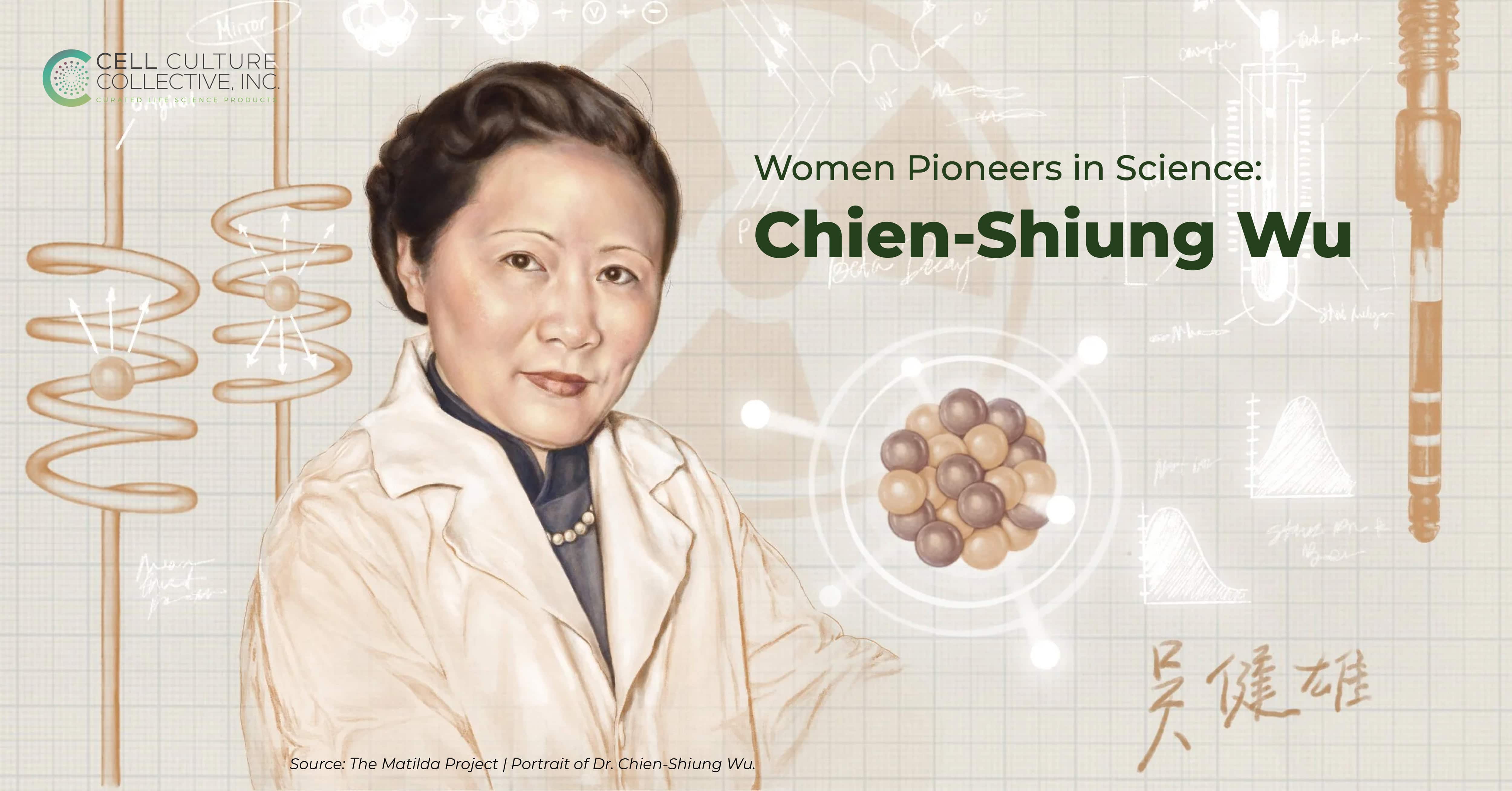
For decades, physicists believed that the laws of nature treated left and right exactly the same. This assumption, known as parity conservation, was considered so fundamental that few scientists thought to question it. By the middle of the twentieth century, it had become one of the certainties of modern physics.
Chien-Shiung Wu built her career testing such certainties. Trained as an experimental physicist and later working at Columbia University, she became known for her exceptional precision in nuclear physics experiments, particularly in the study of beta decay. Colleagues relied on her ability to design experiments that could answer questions theory alone could not resolve.
When physicists began to suspect that parity might not hold under certain conditions, Wu took on the challenge of testing the idea. The experiment she designed would soon overturn one of the most trusted assumptions in physics and change the direction of particle science.

Source: University Archives, Rare Book & Manuscript Library, Columbia University Libraries
The Breakthrough
In 1956, two theoretical physicists, Tsung-Dao Lee and Chen-Ning Yang, proposed a startling idea. The long-accepted rule of parity conservation might not apply to all forces of nature. In particular, they suspected that the weak nuclear force, responsible for certain forms of radioactive decay, might behave differently. It was a bold hypothesis, but it needed experimental proof.
That proof would come from Chien-Shiung Wu.
Working at Columbia University, Wu designed an experiment that could directly test the symmetry of nature. She used radioactive cobalt-60 atoms cooled to extremely low temperatures, aligning their nuclear spins within a powerful magnetic field. This setup allowed her team to observe the direction in which electrons were emitted during beta decay, one of the processes governed by the weak nuclear force.
If parity were conserved, the electrons would emerge symmetrically. The results showed something entirely different. The electrons favoured one direction over the other. Nature, it turned out, did not behave the same in a mirror.
The finding was announced in early 1957 and sent shockwaves through the physics community. A principle that had stood unquestioned for decades was suddenly gone. That same year, Lee and Yang were awarded the Nobel Prize in Physics for the theoretical proposal Wu had just experimentally proven. Wu was not included. The committee recognized the idea. It did not recognize the evidence.

Wu and her colleagues at Columbia University | Smithsonian Institution Archives
Why It Matters Today
Wu’s experiment did more than resolve a theoretical debate. It forced physicists to rethink how the fundamental forces of nature behave. By demonstrating that parity symmetry breaks down in weak nuclear interactions, her work opened a new direction in particle physics and reshaped how scientists understand the structure of matter.
The discovery became fundamental in the development of modern particle physics. The study of weak interactions, including processes such as beta decay, would later contribute to the formation of the Standard Model of particle physics, the framework that explains how fundamental particles and forces interact. Experiments that investigate neutrinos, radioactive decay, and subatomic symmetry continue to build on the principles revealed through Wu’s work.
Beyond theoretical physics, the techniques refined through beta decay research have also influenced applied science. Precision measurements of radioactive decay are used in nuclear medicine, radiation detection, and energy research. The ability to interpret how particles behave at the smallest scales remains central to both fundamental science and technological innovation.
Wu’s experiment reminds the scientific community of something essential. Even the most trusted assumptions must remain open to testing. By carefully designing an experiment that could challenge a long-standing law, she demonstrated the power of rigorous observation in advancing human understanding of the universe.
| Did You Know?
Her hometown built a school just to educate girls. Wu’s father, Wu Zhongyi, was a progressive engineer who believed girls deserved education at a time when that was radical in China. He actually founded a school specifically for girls in their town and Wu was among its first students. Without his unusually forward-thinking values, her entire trajectory may never have happened. |
Why This Month
August is when STEM pipelines visibly activate. University physics and engineering programs begin their academic year, research fellowships commence, and science communicators turn their attention to inspiring the next generation of students. It is the month most directly tied to who enters science and why. Chien-Shiung Wu is precisely the figure that moment calls for.
She earned her PhD from UC Berkeley in 1940, built one of the most technically demanding experiments in nuclear physics history at Columbia University, and did it all while navigating a field that systematically excluded women from authorship, awards, and institutional credit. Her 1956 parity violation experiment required over a year of meticulous preparation and sub-zero temperature conditions using cobalt-60. That level of rigor, achieved under those circumstances, is exactly the kind of concrete, specific story that STEM visibility season needs to tell.
Legacy & Recognition
Wu’s recognition came late, and unevenly but the weight of what she left behind is hard to argue with.
1 in 57 – The year Lee and Yang won the Nobel Prize for a theory Wu proved experimentally. She was not included. It remains one of the most scrutinized oversights in Nobel history.
1975 – The year President Gerald Ford awarded her the National Medal of Science, making her one of the first physicists of Chinese descent to receive the honor in the United States.
1978 – Wu became the first woman to win the Wolf Prize in Physics, widely considered the most prestigious science award after the Nobel.
2752 – The designation of the asteroid named after her, Wu Chien-Shiung, catalogued in the International Astronomical Union registry.
2021 – 24 years after her death, the US Postal Service issued a commemorative stamp in her honor, placing her alongside a small group of scientists recognized at that scale in American public life.
1 building – Columbia University named a campus building after her, one of the few experimental physicists in the institution’s history to receive that recognition.

Source: baike.baidu.com | Chien-Shiung Wu Memorial Hall
Chien-Shiung Wu spent her career proving that precision and persistence are more powerful than institutional permission. She did not get every acknowledgment she deserved in her lifetime, but the work held. The experiment was held. The standard she set held. As science today actively works to build more equitable pipelines, her story is not a cautionary tale about a broken past. It is a working blueprint for what rigorous, fearless scientific contribution looks like regardless of the room it happens in. That is what innovation rooted in inclusion actually produces.