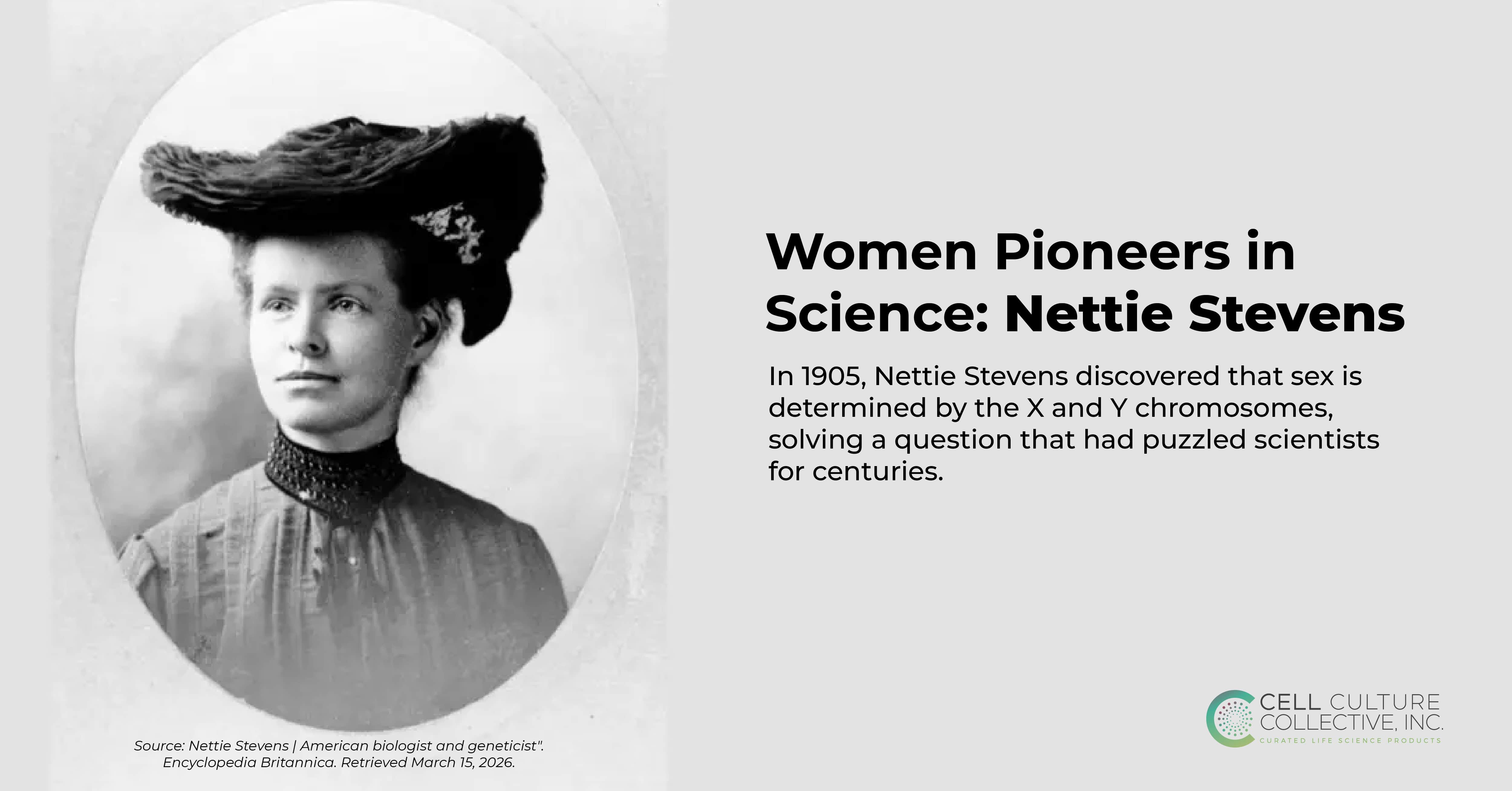
For most of human history, the question of why a child is born male or female was answered with guesswork. Aristotle blamed the temperature of the womb. Others pointed to diet, position, or the mother’s health. By the late 1800s, science had not done much better. Then an intelligent, methodical biologist from a small women’s college in Pennsylvania sat down with a microscope and a colony of mealworms, and solved it. Nettie Stevens looked, counted, compared, and concluded with evidence that sex is determined by chromosomes, specifically by what we now call the X and Y. A finding that neat, that consequential, that precisely executed should have made her a household name. It almost did not.

Source: lynettemburrows.com
The Breakthrough
In 1905, Nettie Stevens published a study titled Studies in Spermatogenesis, based on her examination of the reproductive cells of the mealworm Tenebrio molitor. What she found inside those cells changed biology permanently.
Stevens noticed that female mealworms consistently carried two large chromosomes in their cells, while male mealworms carried one large and one distinctly smaller chromosome. She was looking at what we now call the XX and XY system. Her conclusion was direct and evidence-based: sex is not a product of environment or chance. It is written into the chromosomes of every cell in an organism’s body from the moment of fertilization.
This was a radical idea in 1905. The prevailing scientific belief at the time held that external conditions during development determined sex. Stevens was working against that consensus, armed with nothing more than a microscope, dyed tissue samples, and extraordinary observational discipline. She examined hundreds of cells across multiple species to make sure the pattern held. It did.

Nettie Stevens, second from the left, with friends on the beach near the Cape of Messina, Italy. 1909. Source: www.womenshistory.org
The significance of what she found extends far beyond mealworms. Her work established chromosomes as the physical carriers of hereditary information, a concept that became the backbone of modern genetics. Every conversation today about genetic inheritance, chromosomal disorders, prenatal testing, or sex-linked diseases traces a direct line back to the framework Stevens put in place in that Bryn Mawr laboratory in 1905.
| Quick Fact:
Nettie Stevens funded part of her own early education by teaching school and doing odd jobs before she ever set foot in a research laboratory. She did not begin her graduate studies until she was 35 years old. She made her most important scientific discovery just five years later. |
Why It Matters Today
Stevens identified the chromosomal basis of sex at a time when the word “gene” had not even entered scientific vocabulary. Gregor Mendel’s work on inheritance was only just being rediscovered. The DNA double helix was still five decades away which another woman was yet to find. She was, in a very real sense, working at the edge of what biology even knew how to ask.
What she established then is now the foundation of an enormous amount of modern science. Chromosomal analysis is routine in prenatal care today, used to detect conditions like Down syndrome, Turner syndrome, and Klinefelter syndrome before birth. Sex-linked genetic disorders, including hemophilia and Duchenne muscular dystrophy, are understood and researched precisely because Stevens established that certain traits travel on sex chromosomes. Cancer research relies heavily on chromosomal mapping to identify mutations and abnormalities at the cellular level.
Beyond the laboratory, her framework shapes how modern medicine approaches personalized treatment. Pharmacogenomics, the study of how an individual’s genetic makeup affects their response to drugs, is built on the same chromosomal logic Stevens pioneered. The Human Genome Project, completed in 2003, is a direct descendant of the scientific tradition she helped found.
Stevens did not live to see any of this. She died of breast cancer in 1912, just seven years after her landmark publication. But the science she grounded has only grown more relevant with every decade that followed.
Why May?
May is the right month for Nettie Stevens for several reasons:
- Spring is peak growth and reproduction season, the time of year when the biological processes Stevens studied, cell division, chromosomal inheritance, and trait passing, are visibly happening all around us.
- May is when life sciences conversations spike in academic and public circles, with schools wrapping up biology curricula and students engaging with genetics concepts Stevens helped establish.
- It is a month of visibility and recognition, making it a natural moment to correct the historical record and place her name firmly inside the genetics story she helped write.
Legacy & Recognition
Stevens died in 1912 at the age of 50, just seven years after her most important publication. The recognition she deserved did not arrive in her lifetime, and for decades after, it arrived unevenly.
1905 – Stevens publishes Studies in Spermatogenesis, establishing chromosomal sex determination. The finding is initially credited more prominently to her contemporary Edmund Beecher Wilson, despite Stevens reaching the conclusion more directly and decisively.
1912 – Stevens passes away from breast cancer before the full weight of her contribution is acknowledged by the scientific community.
1983 – Historian Stephen Brush publishes a landmark analysis explicitly crediting Stevens as the primary discoverer of sex chromosomes, helping formally correct the scientific record.
1994 – Stevens is inducted into the National Women’s Hall of Fame, one of the few formal institutional acknowledgments of her work.
2017 – Google honored her with a Doodle on what would have been her 155th birthday, bringing her story to a global audience for the first time on a meaningful scale.
Today – Her work underpins every chromosome-level discovery in modern genetics, even as her name remains largely absent from mainstream science education.
Nettie Stevens never had a famous collaborator to share credit with. She had her microscope, her mealworms, and her methodology. That was enough to crack open one of biology’s most fundamental questions. Today, as science makes deliberate efforts to build more inclusive pipelines and recognize contributions that were historically passed over, Stevens is exactly the kind of figure worth returning to. Not as a symbol of what went wrong, but as evidence of what rigorous, independent, curiosity-driven science looks like when it is allowed to speak for itself.