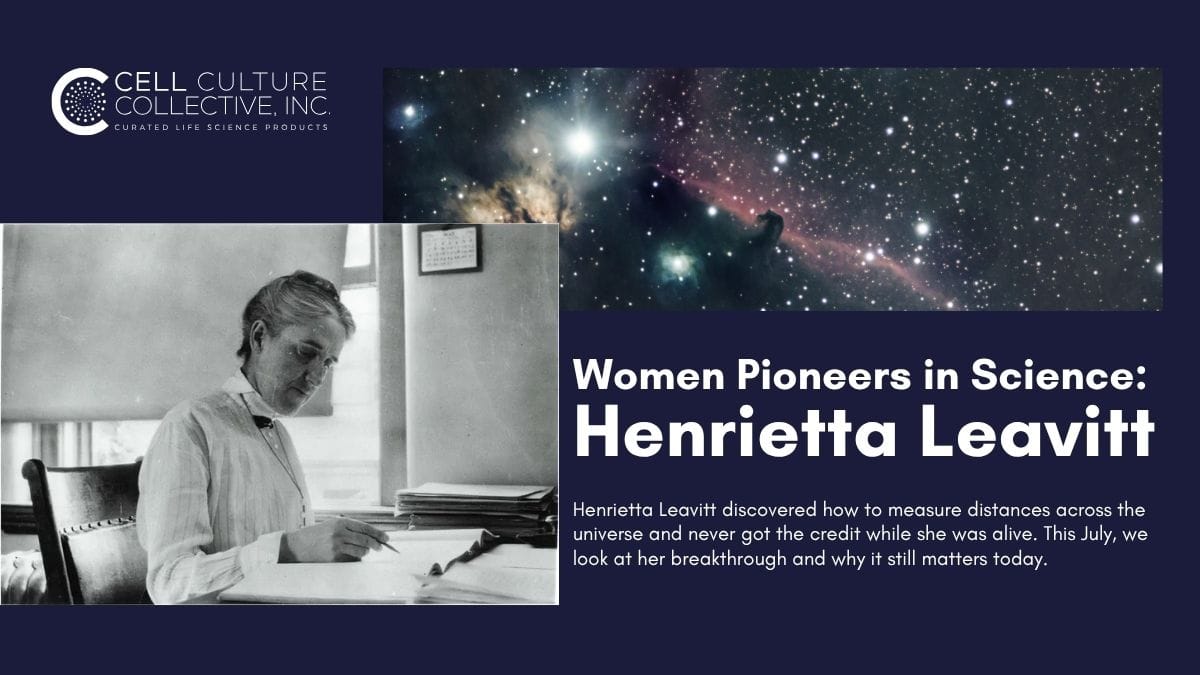
She never once looked through a telescope. Yet Henrietta Leavitt figured out how to measure the size of the universe.
In the early 1900s, Henriette Leavitt sat for hours in a small room at Harvard, studying photographs of the night sky, one of many women hired to do the observatory’s painstaking measuring work, paid a few cents an hour. Leavitt was also going deaf. But in the patterns of certain pulsing stars, she spotted something no one else had: a law connecting how bright a star truly is to how it flickers over time. That single insight became the ruler astronomers still use to measure distances across the cosmos. Without it, we wouldn’t know the universe is expanding or how big it really is.
Harvard gave the title “computers” to women like Henritte Leavitt working in the observatory, long before the word meant a machine, it meant a person who computed. Leavitt and her colleagues were the ones doing the math, by hand, that made the discovery possible.

The Harvard computers in 1918, the so-called “paper-doll” photograph; Henrietta Leavitt is just to the left of center, with a loop of dark ribbon on her blouse; Annie Jump Cannon – peer and friend – is four places to the right of Leavitt (hea-cwww.harvard.edu)
The Breakthrough
Every night, telescopes at Harvard photographed the sky. Every day, Leavitt’s job was to compare those photographs, star by star, hunting for tiny differences in brightness between one plate and the next. It was slow, repetitive work, done with a magnifying glass, on thousands of stars, for years.
Her focus fell on a particular kind of star that doesn’t shine steadily; it pulses, growing brighter and dimmer on a regular cycle, like a slow heartbeat. Astronomers had known these “variable stars” existed for a while. Nobody had found a use for them.
Leavitt kept noticing something odd. The stars with longer pulses, the ones that took more time to swing from bright to dim and back, were also the more powerful stars. The faster ones were fainter. It wasn’t a coincidence here and there. It held up.
That pattern was the breakthrough. If a star’s pulse alone could reveal how bright it truly is, then astronomers no longer needed to guess. They could time the pulse, calculate the star’s real brightness, compare that to how dim it looked from Earth and work out exactly how far away it was.
Leavitt had handed astronomy something it had never had. She delivered a reliable way to measure distances that reached far beyond our own galaxy. She had turned a flickering star into a measuring tape stretched across the universe.

Harvard College Observatory – womenshistory.org
Why It Matters Today
Leavitt’s measuring tape is still in use.
Right now, astronomers using the James Webb Space Telescope point it at distant galaxies, find the same pulsing stars she studied, and apply the same logic she worked out over a century ago to calculate how far away those galaxies are.
That work sits at the center of one of the biggest open questions in physics today: exactly how fast is the universe expanding?
- Using Leavitt’s method, astronomers get one answer.
- Using a completely different method, reading the faint afterglow of the Big Bang itself, they get another.
The two numbers don’t match, and nobody has fully explained why. Scientists call it the “Hubble tension,” and solving it may reveal something new about how the universe actually works.
What’s striking is that this isn’t a piece of history being honored from a distance. Leavitt’s discovery is an active tool, still generating the numbers cosmologists argue over in papers published this year. A woman who was handed tedious measuring work, ended up building an instrument precise enough to still sit at the frontier of physics generations later.
| Did you know?
In 1925, a Swedish mathematician – Gösta Mittag-Leffler, tried to nominate her for the Nobel Prize – only to be told she’d already been dead for four years. The Nobel can’t be awarded posthumously, so she never got it, despite Edwin Hubble himself saying she deserved one. |
Why This Month
July is the month of open skies, long summer nights when the stars are actually out and easy to look up at. It’s a fitting stage for an astronomer.
But there’s a more personal reason Leavitt belongs to July.

First page of paper by Henrietta Swan Leavitt, “Periods of 25 variables in the Small Magellanic Cloud,” under the byline of Edward Pickering, Harvard College Observatory Circular no. 173, 1912 (Linda Hall Library)
She was born on July 4, 1868.
While the rest of the country looks up to celebrate with fireworks, it feels right to also look up and remember the woman who taught us how far those stars really are. Her work turned summer stargazing into something measurable, a science, beyond our view.
This month, as the sky opens up above us, so does her story.
Legacy & Recognition
For decades, Leavitt’s name barely appeared next to her own discovery.
Edwin Hubble built his most famous work on her method and said openly that she deserved a Nobel Prize for it. He never got the chance to make it official.
That could have been the end of the story. It wasn’t.
- A crater on the Moon carries her name.
- So does an asteroid.
- Her work still trains the researchers who go on to win the prize she never got, including a Nobel laureate who first learned to use her method as a young graduate student.
Recognition came late. But it did come.