🧪 Exciting News! We’ve launched our New Lab Program - empowering innovation with cutting-edge research facilities. <a href="https://cellculturecollective.com/new-lab-program/" target="_blank">Explore Now! 🔬</a>

$100.00
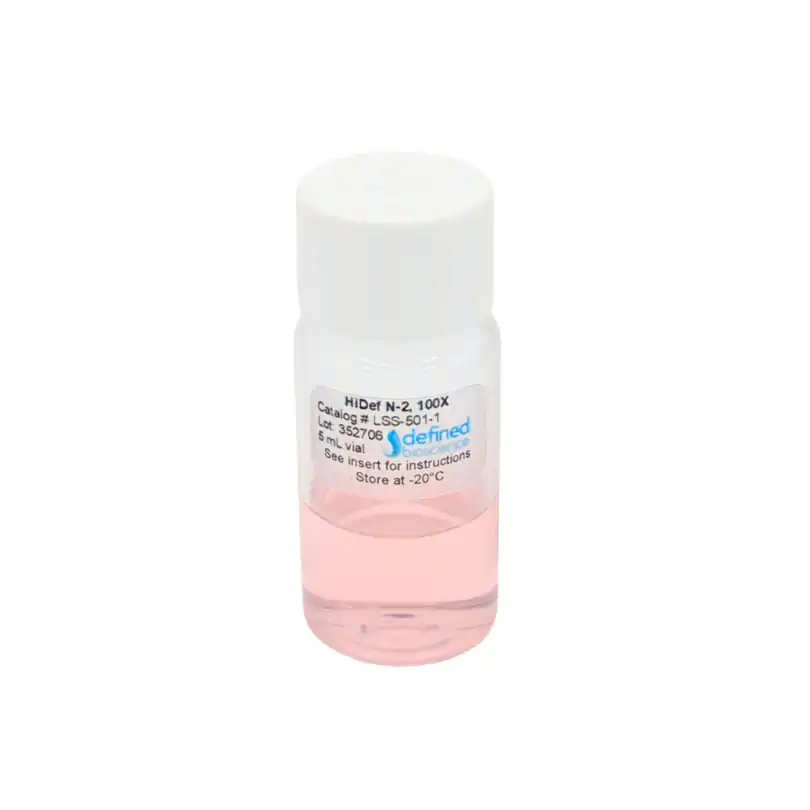
Defined Bioscience’s HiDef® N-2 is a defined formulation designed for the culture and growth of neurons, neural progenitor cells (NPCs), stem cells, and neuroblastoma (NB) cells, among other cell types, as well as differentiation of embryonic and induced pluripotent stem cells in neural and pancreatic lineages. HiDef N-2 is a combination of insulin (to stimulate glucose uptake), transferrin (to facilitate iron transport), sodium selenite (a potent antioxidant and common medium component), putrescine (for cell growth support), and progesterone (for promoting growth and neuronal differentiation and stimulation). N-2 has been historically shown to improve survival and expression of neuronal cells, including neurons in primary culture, and serves as an effective substitute for the N-1 Bottenstein formulation.
HiDef N-2 can be used alone and in combination with other additives and supplements across a wide range of cell culture applications.
HiDef N-2 is provided as a 100x supplement in water, using animal origin-free componentry (contact Defined Bioscience with any complete formulation requests). The supplement is provided in liquid form in 5-mL volumes, sufficient for 500 mL of medium.
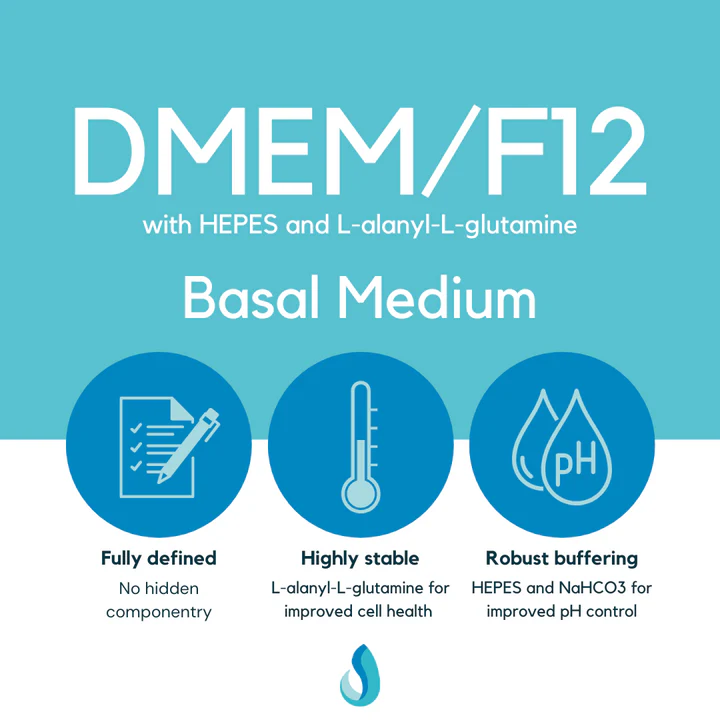
This supplement can be used with a wide range of basal medium formulations, including Defined Bioscience’s fully defined DMEM/F12 basal medium (Catalog # LSB-101).
Each lot of HiDef N-2 is used in combination with basal medium in performance testing in a culture assay evaluating glioma outgrowth and viability.
Sterility: Use appropriate aseptic technique when handling HiDef® N-2. Our HiDef N-2 is sterile-filtered (0.22 µm PES), and so additional sterilization and autoclaving are strongly discouraged. Ensure that all equipment is sterile before use.
Receipt and Preparation: Before using HiDef N-2, ensure that the medium is stored at -20°C and is within the expiration date. Warm the medium to room temperature before use as needed, but avoid warming it above 37°C.
Supplementation: HiDef N-2 is a supplement to be added to a basal medium (e.g. DMEM/F12; Defined Bioscience Catalog # LSB-101). The resulting formulation should be supplemented with other components typically required to support the specific needs of your cells. The recommended concentration of these other components can vary depending on the cell type and application. Consult the literature or manufacturer’s recommendations for the appropriate supplements and concentrations for your application.
pH Adjustment: HiDef N-2 is prepared in water. However, the pH of the medium may need to be adjusted depending on the supplements added, the cell type being cultured, and culture conditions. Use a pH meter or pH paper to adjust the pH to the optimal range for your cells using cell culture-grade HCl and/or NaOH as needed.
Cell Culture: HiDef N-2 can be used for the culture of a wide variety of cell types, including primary cells, stem cells, and immortalized cell lines. Follow standard cell culture procedures for seeding, subculturing, and maintaining your cells. Avoid overconfluent cultures or using old medium, as this can lead to cell stress and reduced viability.
Storage: HiDef N-2 100X can be stored for up to 18 months after the manufacturing date at -20°C if protected from light. Once opened, use the remaining medium within two weeks if stored at 2-8°C or freeze aliquots at -20°C. Discard any remaining medium, and avoid further freeze-thaw cycles. Do not freeze the diluted medium for later use. Storage conditions must be adjusted based on manufacturer recommendations once modified with supplemental products.
Every lab experiment carries more than just scientific weight. It carries the pressure of deadlines, grant expectations, publication goals, and the simple but critical need for results that can be trusted. Yet all too often, experiments are compromised not because of a flawed hypothesis, but because of something much smaller;
Behind every successful experiment is a series of small, consistent choices and often, the most overlooked are the tools we use every day. In cell culture, even the best protocols and techniques can’t compensate for consumables that fall short on sterility, reliability, or performance. Contamination, variability, and unexpected failures rarely
In the intricate world of cell culture, precision is everything. Monitoring plays a pivotal role in ensuring that cells thrive, experiments succeed, and data remains reliable. However, for many researchers, this critical aspect often becomes a source of frustration. From contamination to data inconsistencies, the challenges of cell culture monitoring
A future where new drugs are developed faster, safer, and with greater precision—without relying on animal testing or lengthy clinical trials. A future where treatments are tailored specifically to your genetic makeup, providing maximum efficacy with minimal side effects. This is the promise of 3D bioprinting in drug discovery, a
Imagine a future where your favourite burger doesn’t come from a farm but a lab—produced without slaughter, with minimal environmental impact, and with the same taste and texture you know and love. This is the promise of cell-based meat cultivation, a revolutionary approach that’s reshaping the way we think about
If you’re working with cell cultures, you already know how critical it is to monitor cell viability and growth at every stage. Whether you’re a PhD student in the middle of a crucial experiment, a seasoned scientist in biotech, or part of a cutting-edge research lab, keeping a close eye
The field of cell culture is evolving at an unprecedented pace, driving breakthroughs across biomedical research, drug discovery, and sustainable bioproducts. From 3D models revolutionizing cancer research to bioreactors scaling up production, the innovations in this space are transforming how we approach science and medicine. In 2022, the global cell
Cryopreservation is an indispensable method that underpins modern biological research and biomanufacturing. By halting biological activity through ultra-low temperature storage, cryopreservation ensures the preservation of cellular integrity, enabling long-term storage without compromising viability or functionality. This process is more than just freezing cells; it is a precise science that demands
At the heart of every successful cell-based experiment lies a simple yet powerful factor: cell culture media. Serving as the lifeblood of cells, it provides essential nutrients, growth factors, and environmental stability, acting as a surrogate microenvironment to replicate physiological conditions. Whether you’re growing mammalian cells for research, hybridomas for